18: The Cylinder Escapement
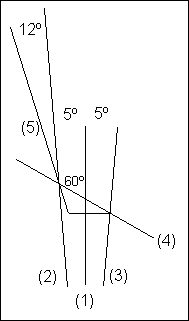
Rotate line (1) counterclockwise by 5° to get line (2) and clockwise by 5° to get line (3). The tooth will occupy a span of 10°, and the escape wheel will rotate 12° per beat, so there will be (no less than) 2° left over for cylinder thickness and for drop. Rotate line (1) counterclockwise by 60° to get line (4); place it on the point where line (1) and the six inch diameter circle intersect. Rotate line (2) counterclockwise by 12° to get line (5); place it on the point where lines (2) and (4) intersect. Line (4) will become the tooth's impulse face. Line (5) will become the back side of the tooth. Draw a curve between them to form a triangle, but give the entrance corner a slightly rounded edge. The curve could be drawn by tracing it over a six inch diameter circle.
 |
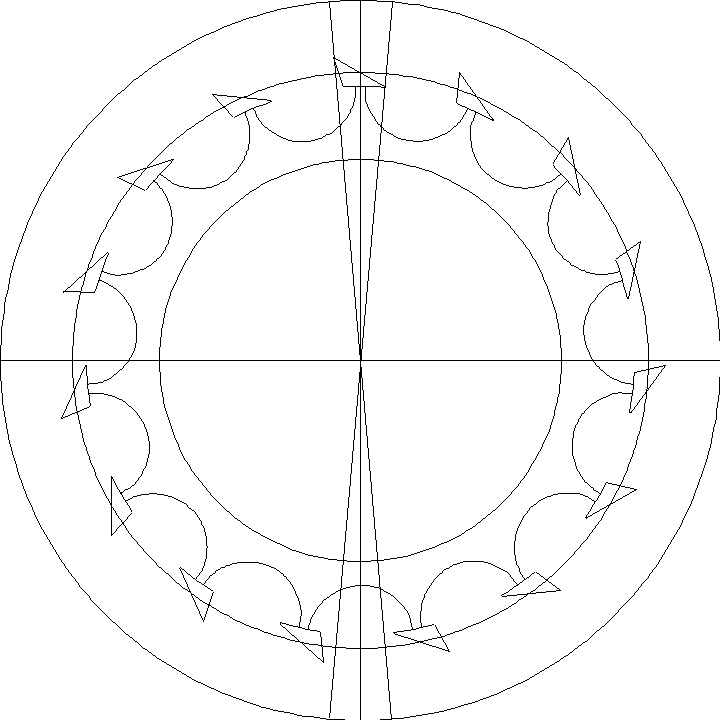 |
Rotate the tooth in the 7.5 inch circle by 24°. Draw a curve to connect the two teeth by tracing over a small circle. Then draw the escape wheel by duplication and rotation, as before.
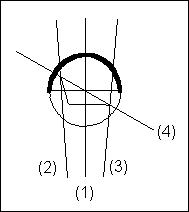
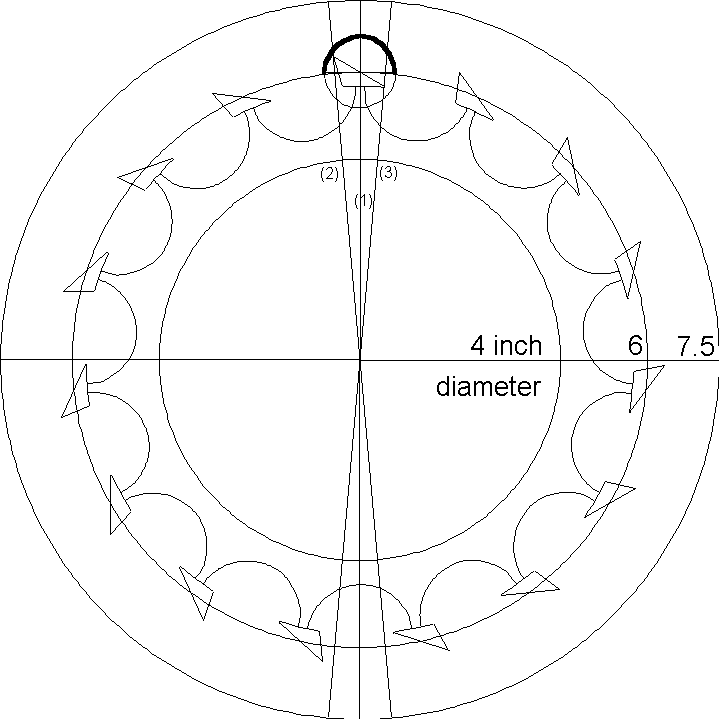
The cylinder will be a circle with two crossing lines and a thick curve traced over the edge of the circle.
 |
The thick curve will cover just over half the circumference of the circle. The
inside diameter of the curve will be slightly greater than the diameter of the tooth. I
chose a circle diameter of 0.73 inches (by trial and error). Place the cylinder such that
its center lies on the point where the six inch diameter circle and lines (1) and (4)
intersect.
 |
 |
Increasing the diameter of the cylinder circle results in a proportional increase in the
inside drop and an equal decrease in the outside drop.
The tooth impulse face's angle and length determine the lift. The cylinder occupies
just over half a circle in order to create lock: if it occupied half a circle, there would be
no lock.
A tooth impulse face angle of 45° would be more efficient, but this tooth does not fit
inside the cylinder as well as a tooth designed with an impulse face angle of 30° because
it would result in unequal inside and outside drops. In practice, cylinder escapements
appear to have escape tooth impulse faces with angles of less than 30°.
Go to Table of Contents
Go to Escapements