22: The Double Roller
In this chapter, we will design the pallet fork and the double roller for the last
drawing of the Swiss Lever Escapement in Chapter 15. Once the drawing with the
theoretically correct impulse face angle of 45° is completed, it must be modified slightly
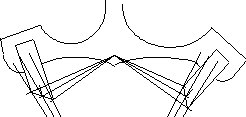
to correct the 1° out-of-angle condition, which could be corrected in two ways. The fork
and roller table could be rotated together by 0.5° using the pallet circle center as the
center of rotation. The second method involves changing the angles of the impulse faces
to compensate. If these angles were changed from 45° to 49°, the amount of lift of each
pallet during impulse could be equalized (though there would be a small efficiency loss
of 0.5%):
 |
This was not mentioned in Chapter 15 in order to focus attention upon the need to
maximize the efficiency of the impulse face angles. The result is two identical pallets
with impulse face angles as close to 45° as possible.
In the drawing, the pallets rotate by 18° in every beat. If the pallet fork were three
inches long and it were assumed to rotate by 26° in every beat while in contact with the
roller jewel (in order to create plenty of depthing for the simulation), and the roller jewel
were assumed to rotate by 30°, we could draw these triangles, which would be used to
calculate the roller jewel's circle radius (X).
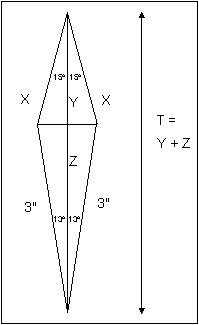 |
X = 3 sin 13 ÷ sin 15 = 2.607"
The distance between the pallet's circle center and the roller jewel's circle center
is given by T:
T = 2.519 + 2.923 = 5.442"
Draw a pallet fork with a distance of 3 inches from the pallet's circle center to the
edge of the fork horn. Draw a roller jewel in a circle with a radius of 2.607 inches and
place it at a distance of 5.442 inches from the pallet's circle center.
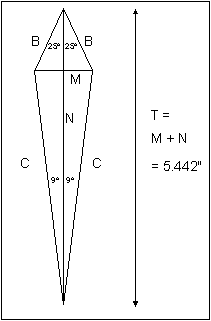
The double roller has two roller tables, the larger one for the roller jewel and the
smaller one for the safety action. You need to find what dimensions the smaller table
needs to have to ensure proper safety action.
 |
|
B sin 25 = C sin 9 (i) |
Draw a small roller table with a radius of 1.522 inches and center it inside the roller
jewel's circle. Draw the guard pin with a radius of 4.113 inches from the pallet's circle
center. Draw a notch in the smaller roller table that would allow the guard pin to clear it
because the latter would have a depth of 0.192 inches.
To place the banking pins, rotate the pallets by 9° from the vertical position, or until
the pallet has just released the escape tooth, plus 2° extra for slide, for a total of 11°.
Place a small circle next to the pallet fork in an appropriate position. Repeat on the other
side.
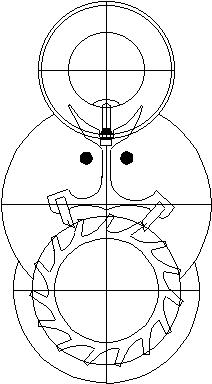 |
Rotate the pallets until a tooth is released: this is the "drop-lock position." Rotate the
roller table until the safety notch is just beyond the guard pin, which appears to be
pressed against the safety roller. Draw the fork horn just outside the path of the roller
jewel, and extending to the jewel's other side, as shown. This design prevents premature
unlocking. Repeat on the other side.
The fork rotates by 18° in each direction while the guard finger is in the safety notch.
The fork also rotates by 18° in each beat. This way there is lock whenever the guard
finger is against the safety roller: if there were no lock, there would be no draw to keep
the guard finger away from the safety roller.
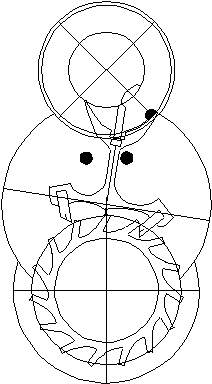 |
There is also a small gap between the fork and the banking pin. This slide is
necessary to keep the guard finger away from the roller table. It also creates "fork horn
freedom," which is the freedom of movement the fork has between the roller jewel and
the banking pin in this position, but notice that the guard finger prevents the fork horn
from touching the roller jewel at this point.
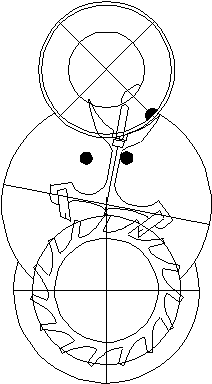
Rotate the pallets by 2° further, until the fork is pressed against the banking pin. By
increasing the angle that the fork is in contact with the roller jewel during rotation from
18° to 26°, you create depthing to make sure that, when the roller jewel returns to unlock
the pallets, the roller jewel would engage the fork below its entrance corner. This is the
same as making the fork longer: if the fork were too short, there may not be enough
depthing.
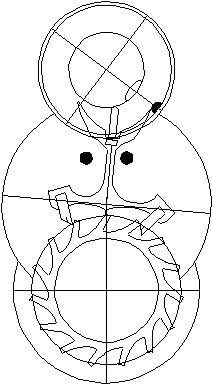
If the guard finger were too short, the fork horn may get in the way of the roller
jewel, and overbanking may occur. Guard finger freedom would be increased, and if it
increased to the point where the pallet were allowed to unlock the tooth, there would be
binding because the guard pin would be pressed against the roller table as the escape
tooth pushes on the pallet's impulse face. Conversely, if the guard finger were too long,
there would be no gap between the guard finger and the safety roller when the fork is
pressed against the banking pin. This gap is called "guard finger freedom."
 |
In this drawing, the guard pin is too short. The escape tooth is pressing on
the pallet's impulse face as the guard pin is pressed against the safety roller, causing
severe frictional losses. The fork horn is blocking the path of the roller jewel.
 |
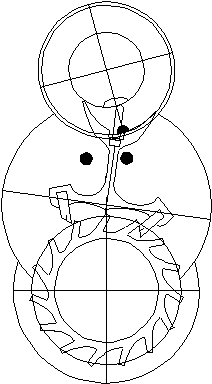
If the pallet unlocked prematurely, just before the roller jewel were to begin to unlock it,
binding might occur. There needs to be enough lock so that when the fork horn is pressed
against the roller jewel before it could completely enter the fork slot, the pallet does not
unlock the escape tooth. There also needs to be some slot corner freedom, or the shake of
the fork between the banking pin and the roller jewel in this position: here the guard
finger could enter the safety notch and so could not prevent premature unlocking, so this
position must be checked very carefully.
 |
The fork slot must be slightly wider than the width of the roller jewel:
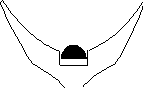 |
It should be clear that with the freedom of the roller jewel, the slot corner freedom,
the fork horn freedom, the guard finger freedom, and the side-shake of the pivots in the
jewels of the escape wheel, the pallet fork and the balance wheel, there needs to be
enough lock in the drop-lock position to prevent unlocking while the parameters of these
variables are tested. There also needs to be enough depthing of the roller jewel in the fork
slot in case the slide needs to be increased to ensure enough guard pin shake.
The most important advantage of the double roller over the single roller is the ability
to increase the depth of engagement of the guard finger into the safety roller. Increasing
the depth reduces the likelihood that the pallet fork might accidentally move across to the
wrong side.
Lock and slide and the angle of the locking face together result in the small binding
action that keeps the guard finger away from the safety roller after each beat, a binding
action that is referred to as "draw." If the design had insufficient draw, consider what
would happen if the guard pin rubbed against the roller table.
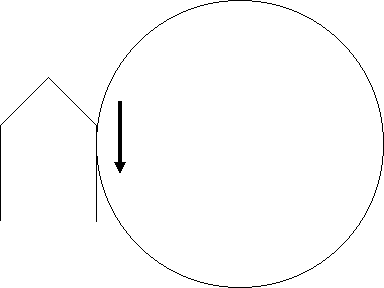
If the guard pin rubbed against the safety roller on the side, the oscillation of the
balance wheel would be interfered with, and the symmetry of the action of the balance
wheel would be altered, affecting the timekeeping.
 |
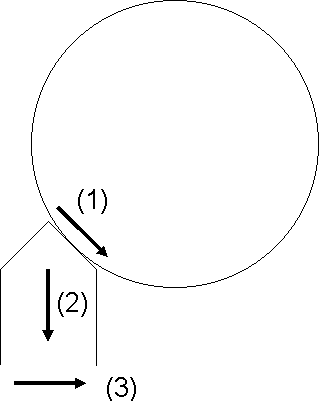
The power loss increases dramatically if the guard pin rubs the safety roller from a
different angle. Here, the safety roller exerts a force (1) upon the guard pin that could be
seen as pushing the pin towards the pallets, shown by arrow (2), and as pushing the pin
towards the other side, shown by arrow (3). Arrow (3) shows that this arrangement has a
binding effect when the guard pin is pressed against the roller table. The drawings on
pages 82 and 84 reveal a similar binding effect, and the latter is compounded by the
escape tooth pushing on the pallet's impulse face. The banking pins are adjusted wide
enough to create enough draw to keep the guard finger away from the safety roller, and
far enough away to reduce the likelihood that the finger might touch the roller if the
watch were jolted.
 |
Look back at the chapter concerning the Duplex escapement to see how the
relationship between the escape wheel's locking tooth and the locking jewel would result
in a similar binding effect. The same binding effect could be found in the Cylinder and Duplex escapements.
It is naturally assumed that the timepiece should be adjusted to maximize efficiency,
but there is one criterion that is more important than efficiency and for which some
efficiency should be compromised: symmetry of action. A fine watch might be adjusted
for maximum efficiency by adjusting for only a very small amount of drop-lock and a
very small amount of run to the banking, in order to minimize the power losses caused by
draw. The watch may run very well on the timing machine, keeping consistent time in all
positions. However, when worn on the wrist, this watch would become erratic,
particularly if the owner were very active. This is because the movements on the wrist
would cause the fork to interfere with the movement of the balance wheel, even if only
occasionally and only momentarily. The watch may otherwise appear to run well. If the
lock and slide were increased slightly to ensure better action, the watch would be a more
consistent timekeeper, even though a small amount of efficiency may be compromised in
the adjustments. The power lost in unlocking (caused by draw) should not be seen as
wasted because draw serves such an important function. The locking angle, the drop-lock
and the run to the banking should be the same on both sides, in order for the forces of
action and reaction to be symmetrical on both sides.
You could use computer simulations to see the effects of problems caused not only by
maladjustment but also by design defects. For example, you could observe the action of
an eccentric escape wheel, or what would happen if you installed an escape wheel that is
over or undersized. You could observe the effects of having the wrong pallets, too thick
or too thin, or the effect of having one jewel set further out than the other, resulting in the
fork being "out of angle." What would happen to the adjustments if the temperature
changed and the metals in the watch expanded or contracted slightly? By creating your
own drawings and experimenting with changes in the variables, you will increase your
understanding of escapements considerably, and this knowledge will add to your skills at
the bench.
Go to Escapements