9: Other Design Considerations
In previous chapters, all the pallet designs were created with an emphasis on
symmetry so that the impulse received by the pendulum would be equal in each
direction. All designs, whether for clocks or watches, should be based on the same method of vector analysis. This should be clear because of the simple method of drawing one type of escapement over another, as shown in chapters 6 and 7. Draw the impulse face first, and then the rest of the pallet.
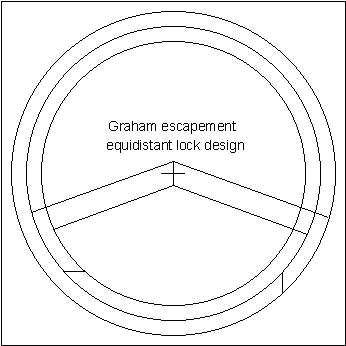
In watch theory, the symmetrical design is referred to as either a "circular" design or an "equidistant impulse" design. In the circular design, the impulse faces are bisected by the same circle. However, the entry pallet's locking face is outside the circle, and the exit pallet's locking face is inside the circle. The locking faces are obviously not symmetrical. This problem is unimportant in pendulum clocks, but it is an issue in watches.
 |
If the pallets were modified to make them with equidistant lock, the locking faces would be drawn on the same circle. However, the pendulum would receive unequal impulses in each direction. A pallet with equidistant drop could also be designed, but it has no practical application in horology.
 |
The Graham pallet has curved locking faces in order to achieve what we call a "dead-beat," where the escape wheel does not move either forwards or backwards during lock. When the escape wheel is pushed backwards, there is recoil. In clocks, a dead-beat action is preferred because the movement of the pallets is controlled by the pendulum at the point where, for example, the crutch pin goes into the suspension leader. At no time are the pallets independent of the pendulum.
Modern Swiss watches have pallets that are independent of the balance
wheel's movement most of the time: this system is referred to as the "detached lever." The single and double-rollers are designed so that the pallet fork would not accidentally jump across to the wrong side of the roller jewel if the watch were jolted by a fall, for example. In addition to the roller table, it is necessary to keep the pallet fork over to the side, in its place, until the roller jewel returns. If the escape wheel were allowed to move forwards slightly, beyond the entrance corner, as the pallet moves over, then it would be necessary to move the escape wheel backwards by the same amount when the roller jewel returns to unlock the pallet. The need to push the
escape wheel backwards slightly results in a small binding action, whichencourages the pallet to stay in its place. Watch pallets, therefore, instead of having curved locking faces, have flat locking faces at an angle of about 15° from the escape circle radius at the pallet entrance corner, such as to make the escape wheel rotate by about 1° extra. Watchmakers call this "Draw."
An equidistant lock design is important in watches because of the need for symmetrical lock. In a circular design, the locking faces are at unequal distances from the pallet center, causing a need for unequal torque to unlock, torque that adversely affects the oscillation of the balance wheel. Any asymmetry in the oscillation of the balance wheel could add to a factor that causes positional error, such as the poise of the balance wheel.
Since clocks do not have pallets that are independent from the pendulum,
there is no need for draw. Therefore, the equidistant lock design is of no advantage in pendulum clocks. The equidistant impulse design is the obvious choice for the Graham, Recoil, and Brocot escapements. (It cannot be applied to the Pin Wheel escapement, as its drawing demonstrates.)
The same principles of lock and draw apply to pin pallet escapements in
watches and clocks with balance wheels, but the impulse and locking faces and the angle of draw are designed into the escape wheel's tooth rather than the pallet. (A pin pallet escapement for a pendulum clock, such as the Brocot, requires no draw and should have a dead-beat action.)
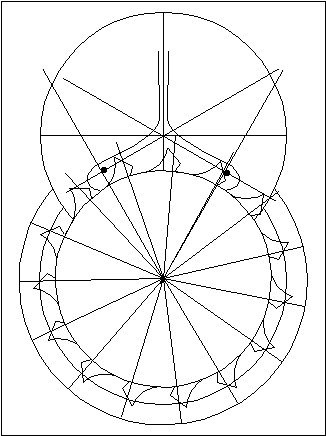
If you look at a clock with a floating balance, such as a Hermle, you would
see that the impulse face is part of the escape tooth. In a drawing, the pallet radius lines bisect the pallet pins. The escape radius lines bisect the impulse faces of the teeth. The locking faces of the escape teeth are not parallel to the escape radius lines, but appear to lean forwards to create draw. The length of the escape impulse face lines is shortened to allow for at least 1° of drop, and these lines are at 45° to the escape circle's radius lines that bisect each of them.
 |
By drawing the different escapements, you could see how the principles, by which
they are formed, apply to all of them. They may look different, but they actually behave in
similar ways.
Table of Contents
Escapements in Motion
Clock Repair Main Page
Links Page