Dating your British grandfather clock. . .
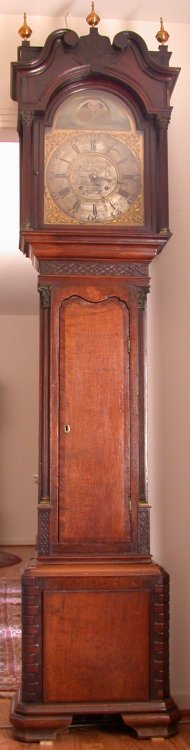
. . . or, should I say, "How to determine the age of your British grandfather clock." Between about 1780 and 1870, floor clocks from England, Scotland, and Wales were made with painted dials, which were probably much less costly to make than the earlier dials with polished brass and filigree artwork. The following information was once on a webpage offering a clock for sale. Once the clock had been sold, the webpage was removed from the internet, but not before I had saved the information. Since it would be useful to clock collectors, I present this information here verbatim:
"It's quite easy to date a painted dial longcase clock. Follow the simple instructions below and you'll soon get the hang of it.
They fall into three distinct types, commonly known as period one (1770-1800), two (1800-1825) and three (1825-1860).
PERIOD ONE:
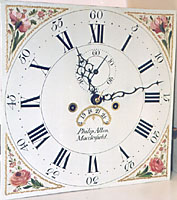
Period one dials date from about 1770 to about 1800 and look more or less like this:
The hour numerals are in Roman lettering (FROM I to XII) and the minute numerals are in arabic (5 to 60) numbered every five minutes (often called five minute numbering).
PERIOD TWO:
Period two dials change in three distinct ways.
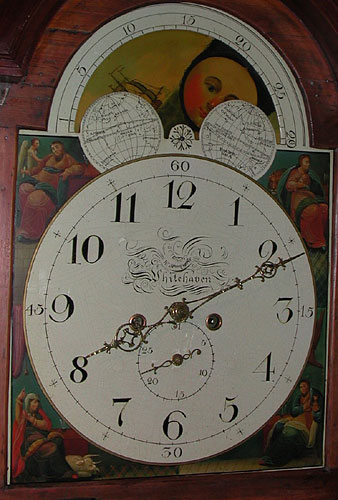
Whereas period one corner decoration tends to be simple gold scrollwork OR little flowers, fruit or the occasional bird, period two dials tend to have either geometric shapes, or shells, or abstract patterns - usually with a little more colour than period one. This dial is typical of about 1800:
Period two dials start to lose the five minute numbering and this is replaced with fifteen minute numbering (15,30,45,60) possibly in slightly smaller size, around the hour numbers. The Hour numerals are often in arabic rather than roman style.
Period two tends to cover the period 1800 to 1825-30.
PERIOD THREE:
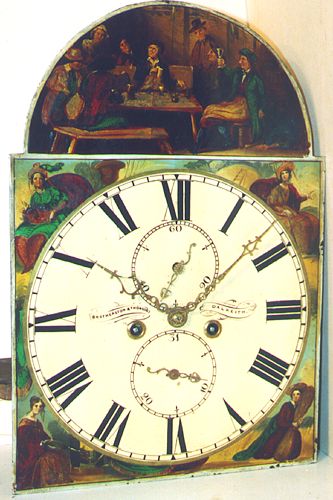
Period three dials are from 1830 onwards until the demise of longcase clockmaking about 1850-70.
The minute numbering has disappeared completely and the hour numerals are back as Roman numerals, (I, II, III, IIII, V, VI, etc..) The corner decoration tends to be full colour scenes, often of country scenes, sometimes of the four seasons, countries (England, Scotland, Ireland, Wales) or the four continents. Sometimes there are specific corner or arch paintings to do with trade or commerce or perhaps with a religious or masonic theme."
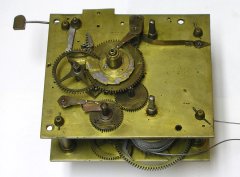
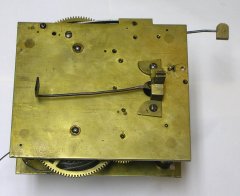
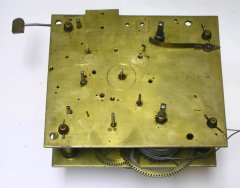
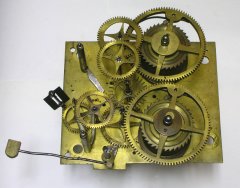
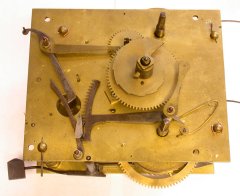
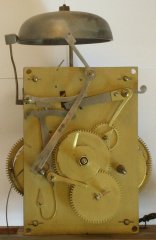
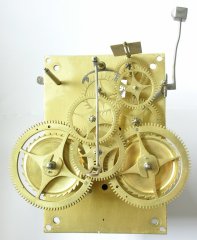
Most of the mechanisms from this period look like these:
The Alarm:
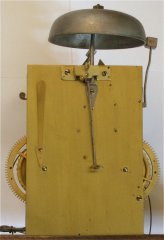
Here is an alarm mechanism on another English grandfather clock of the same vintage, ca. 1790. The basic design of this alarm goes back by maybe a thousand years!
Here you can see the alarm hammer with the bell removed, and this is where the enormous significance of the alarm mechanism for the evolution of timekeeping becomes clear: if you add another hammer on the other side, you have a foliot, (developed around 1285).
If you place a wheel or a disk to replace the hammers, you have a balance wheel, (developed by Peter Henlein in Germany in 1510).
If you rotate the axis of rotation (the arbor or shaft) by 90° to a horizontal position, the hammer becomes a pendulum. The first clock to use a pendulum instead of a foliot or balance wheel was produced by the Dutch mathematician Christian Huygens in 1657 (although it is claimed that others invented the pendulum clock before he did), so you can see how the alarm mechanism formed the basis of the clock escapement to be used for timekeeping in the thirteenth century and beyond. The crown wheel was used in clocks and watches in England until about 1840, even though the anchor escapement for the pendulum clock had already been introduced in 1657. The recoil action of the two escapements is similar, if you consider the crown wheel as a three-dimensional escape wheel and the anchor escapement as having a two-dimensional escape wheel. You can read more about this:
The Origin and Evolution of the Anchor Clock Escapement
Clocks: The Heritage of the Christian Faith
Elliott 9 Tube Grandfather Clock
Clock Repair Main Page
Escapements in Motion
Links Page