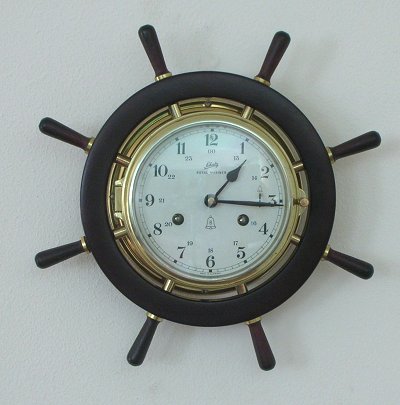
Schatz Royal Mariner Clock (1975)
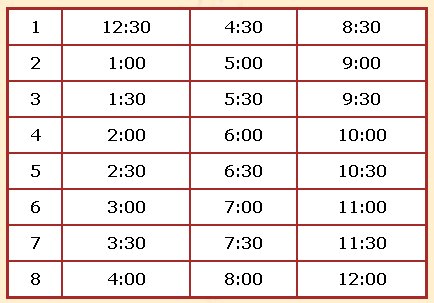
This page offers tips for repair of a Schatz Royal Mariner ship's bell clock. The principles are the same for other Schatz ship's clocks and similar for Chelsea ship's bell clocks. The sequence for the bells is the same.
 |
 |
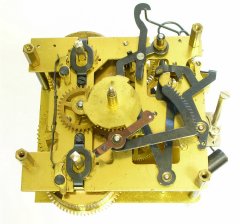 |
Fig. 1
There is not much to see from the back of the clock.
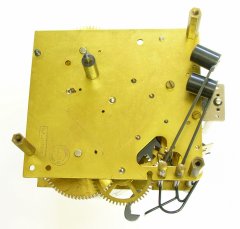 |
Fig. 2
There is a wealth of information in Figure 3 (click on the images to see the enlargements). At the moment the strike lever falls into the recess of the gathering pallet [A], the hammer detent lever rises just as the hammer is released [B]. It is important for the gathering pallet to be adjusted so that striking stops as soon as the last hammer is released, or this feature will not work. The strike gear train is stopped when the strike lever falls to impede the rotation of the warning wheel [C]. There is a cam on the centershaft that determines the position of the hammer detent lever. When the cam raises the lever, this is the half-hour position. Each step on the snail has two positions(the half-hour and the hour). If you compare the half-hour position in Figure 3 and the hour position in Figure 4, this will become clear. I have seen several ship's clocks that were not correctly adjusted because the repairer did not understand it.
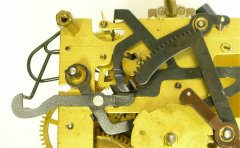 |
Fig. 3
In Figure 4, the hammer detent lever misses because the cam on the centershaft does not raise the lever. This is the hour position.
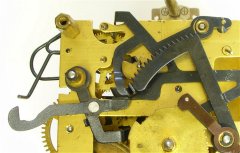 |
Fig. 4
Most of the parts have been removed from the front plate in Figure 5. It shows how the mainspring barrels are installed and how easily the barrels can be removed without taking the entire clock apart.
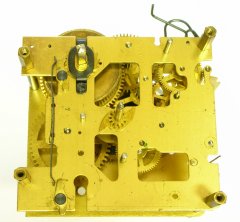 |
Fig. 5
Figure 6 shows the tools used to remove the gathering pallet. It is important that the gathering pallet be pulled upwards and not to one side (the shaft could bend or break).
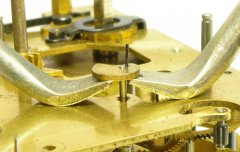 |
Fig. 6
The arrangement of the gears is shown in Figure 7, after the back plate has been removed.
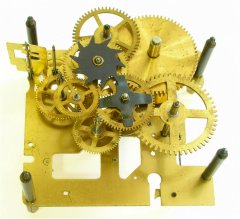 |
Fig. 7
Figure 8 shows the platform escapement of the Schatz clock. It has a pin pallet escapement. The most important problem that happens with this platform is that the bushings for the escape wheel wear and need to be rebushed. An improvement would be to install friction jewels to replace the bushings, though the effort may not be justified in an escapement of this quality. This Schatz clock was sent from Long Island, NY.
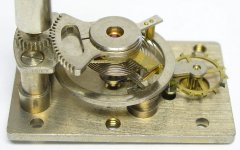 |
Fig. 8
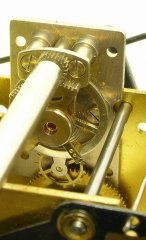 |
Fig. 9
Here is the platform with a Seitz jewel (22/160) above the escape wheel, installed for the purpose of taking this photo.
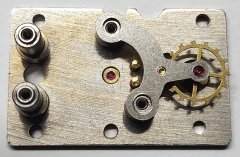 |
Fig. 10
When you compare the Schatz clock with a Chelsea ship's bell clock of similar vintage, there are several obvious differences. The Chelsea is better made, with polished pinions and gold-plated brass gears. The Chelsea platform has a Swiss lever escapement with 11 jewels. The Chelsea costs many times more! Chelsea clocks in general are more difficult to work on than Schatz and other equivalent clocks, so repairs on Chelseas should not be attempted by those without at least five years of experience at the bench and some watch repair experience. Schatz clocks are no longer being manufactured, but Chelsea clocks are. Another manufacturer of ship's bell clocks that should be mentioned here is Hermle.

|
The new Hermle ship's bell clocks have platforms with plastic escape wheel and pallets. I avoid clocks with escapement parts made of plastic. The second wheel bushing on the front plate of the Hermle is very close to the edge of the plate, making the replacement of the bushing difficult. If you buy a new mechanical ship's bell clock that is not a Chelsea, it probably has a Hermle mechanism.
Some Schatz History:
Schatz went bankrupt in 1982 and taken over by Staiger, which
was a very experienced clock manufacturer. They were the first
to develop a quartz controlled movement for clocks and bring
it onto the market. However Staiger continued to build the little
mechanical clockwork 39 until 1993, when it was discontinued
and was replaced by the Hermle mechanical clockwork. Today
Hermle and Chelsea Clocks are the only mechanical ship’s bell
clockwork manufacturers on the world market.
Our current electric ship’s bell clockwork was developed
by Staiger at the subsidiary UTS in Haardt around 1985.
There are not many documents about Schatz, everything destroyed after the bankruptcy around 1983. August Schatz in Triberg built from 1958 the large mechanical clockwork (left) until around 1978, when this clockwork was discontinued and replaced by the small clockwork 39 which had been developed around 1960/65 for the Miniaturschiffsglasenuhr (illustrated in Firmenchronik 1881-1981 page 14, find German pdf link below) and Midi.
At the end of the 1970s, the Royal housing was changed so the small clockwork 39 could be fitted. The first battery-powered clock was developed in1956. It used a 4,5V battery. But already in 1958 the first 1,5V battery-powered clockwork was launched.
From then on, many different battery-powered clockworks were launched in different series through the 60s and 70s and it was as late as 1980 the first battery-powered ship’s bell clockwork was introduced (Schiffsquarzwerk mit Glasenschlag, also illustrated in the Firmenchronik 1881-1981 on page 16).
In 1992 the two companies Staiger and Kundo, which had
been cooperating since 1980, were merged and in 2000
Kundo-Staiger went bankrupt. Altitude took over the Schatz
business from here and in the first years produced the Schatz
instruments in La Chaux-de-Fonds in Switzerland (close to
Morteau in France). However after some Years the production
was moved to Altitude in Morteau. In 2012 Delite in Måløv,
Denmark took over the Schatz production and the year after
Delite took over the rest of the Altitude business. [SOURCE] and [
pdf or
pdf in German] and [
pdf in an English translation].
Here is the original instruction manual for your Schatz Royal Mariner.
Clock Repair Main Page
Escapements in Motion
Links Page